

Why Willpower Isn't Enough
Think about your morning routine. You wake up. You walk to the sink. You brush your teeth. You brew coffee. Do you stop to debate the merits of these actions? Do you have to concentrate intensely to find the toothbrush?
Probably not. That is because your brain is on autopilot.
Research from Duke University suggests that over 40% of the actions you take every day are not conscious decisions. They are habits.
Society tells us that to change our lives, we need "grit" or "willpower." That is actually incorrect. Willpower is a limited resource. It runs out like a battery. To create lasting change, you do not need to fight your brain. You just need to understand the machinery under the hood.
The Efficiency Engine
Why does the brain do this? Simply put, the brain is trying to save energy.
Conscious decision-making takes a lot of effort. If your brain had to analyze every single aspect of walking, eating, or driving every time you did it, it would overheat.
So, when a behavior becomes repeated, the brain moves it from the conscious cortex to the basal ganglia. This is a primitive part of the brain responsible for automatic patterns. It turns a complex sequence of actions into a single "chunk" of behavior.

The Habit Loop
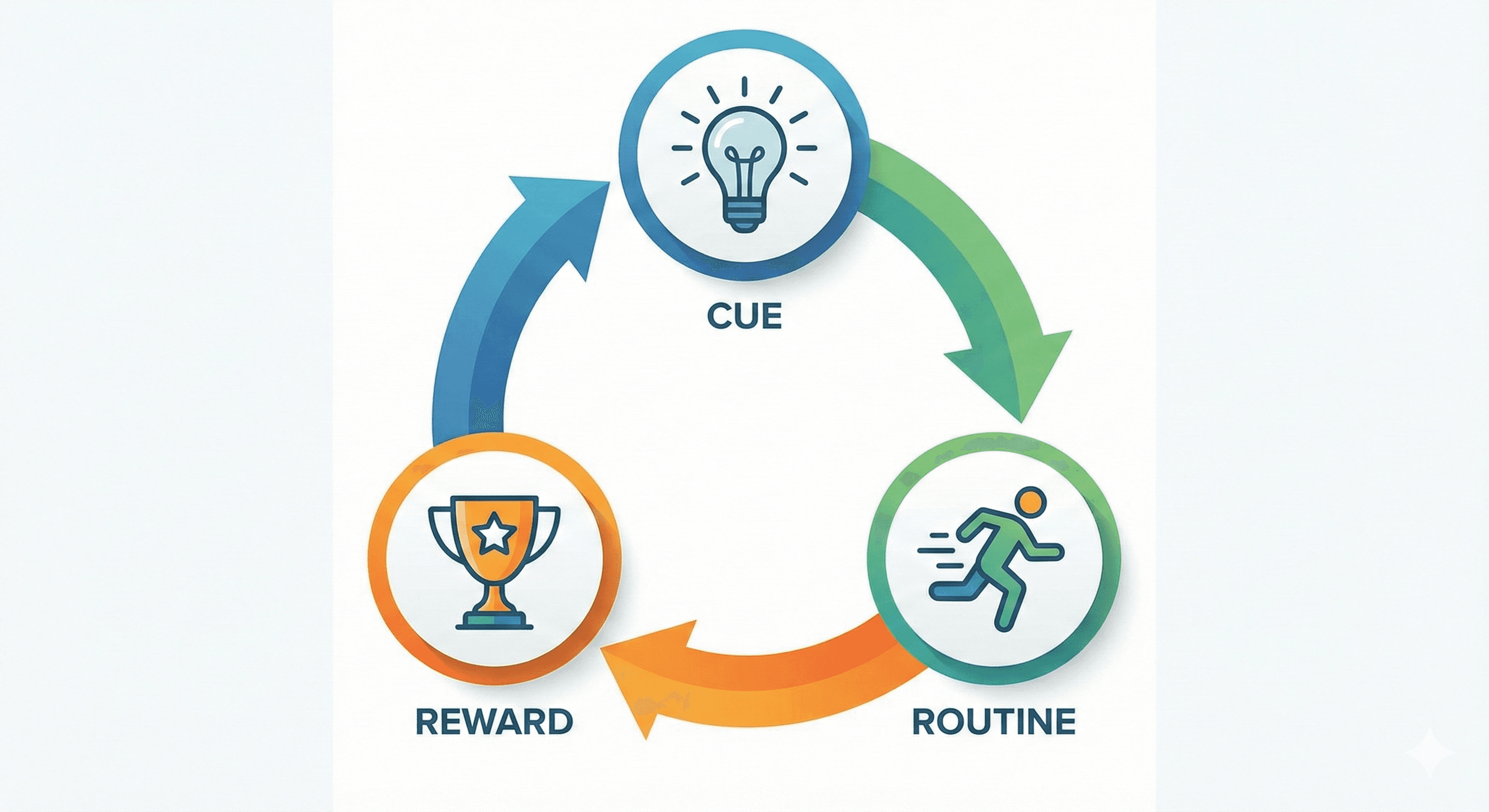
MIT researchers discovered that every habit, regardless of complexity, follows the exact same three-step neurological loop. Understanding this loop is the first step to taking back control. Cue. This is the trigger that tells your brain to go into automatic mode. Next comes the Routine, which is the behavior itself. Finally, there is the Reward. This is the prize that tells your brain this loop is worth remembering for the future.
The 3-Step Cycle
1. The Cue
This is the spark. It acts like a start button on a machine. It could be a specific time of day, a location, a sound, or an emotional state like boredom or stress. It signals your brain to power down conscious thought and execute a stored program.
2. The Routine
This is the action itself. It is what we usually think of as "the habit." It can be physical, like eating a donut. It can be mental, like spiraling into negative thoughts. It is simply the automated response to the cue.
The Golden Rule of Change
Here is the secret to breaking a bad habit: You cannot simply erase it.
The neural pathways are already physically carved into your brain. Trying to stop a habit by saying "I will just stop doing it" is like trying to stop a river by yelling at it. It rarely works for long.
Instead of erasing the habit, you must overwrite it. This is the Golden Rule of Habit Change:
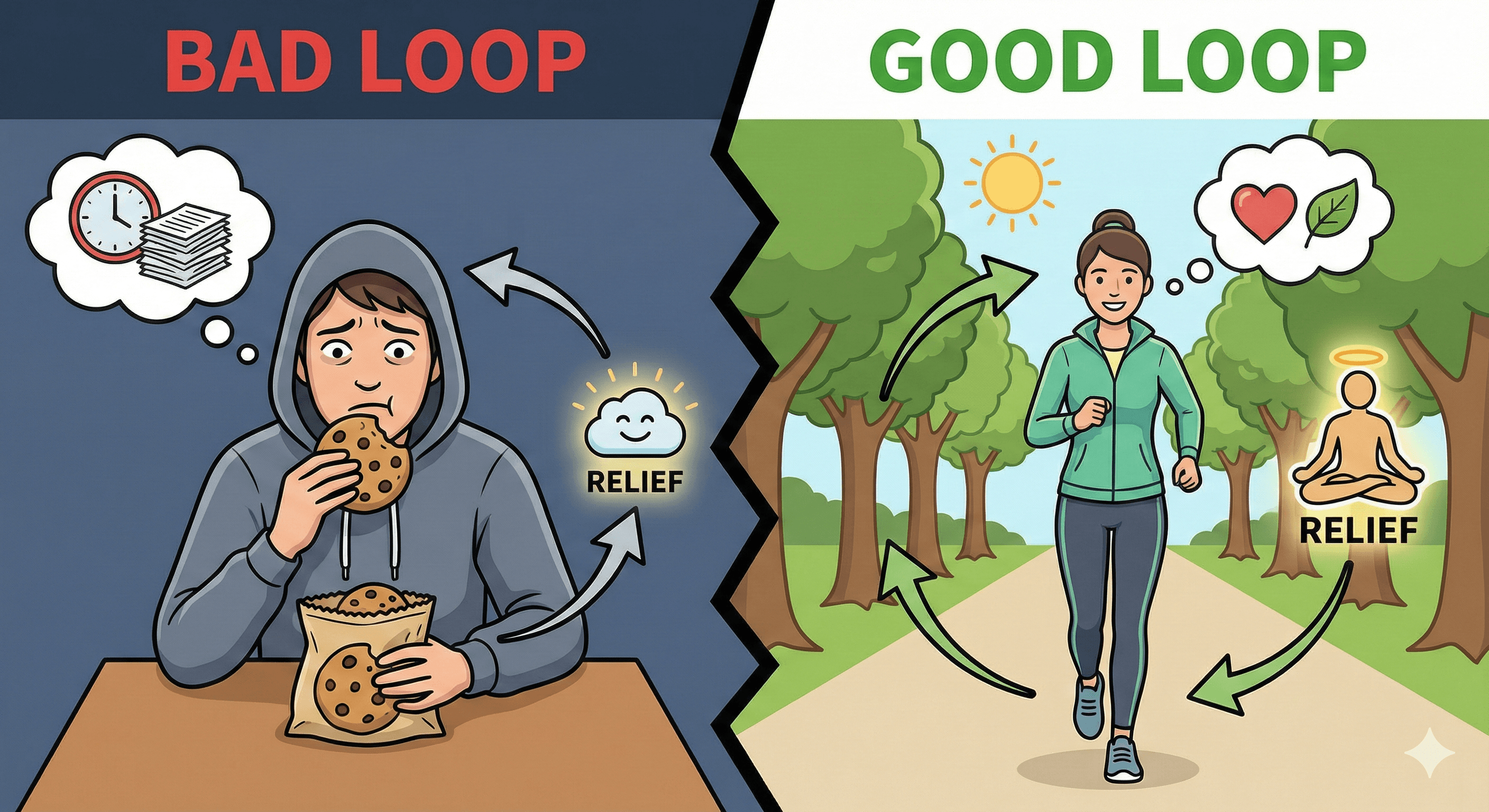
You must keep the old Cue, and deliver the old Reward, but insert a new Routine.
A Practical Example
The Afternoon Slump
Let's look at a practical example. Imagine you have a "bad" habit of eating a cookie every afternoon at 3:00 PM. You want to stop because of the sugar, but you keep failing.
The Diagnosis:
The Cue: It is 3:00 PM and you feel a bit tired at your desk.
The Old Routine: You walk to the cafeteria and eat a cookie.
The Reward: You feel a sugar rush, but more importantly, you get a break from work and social interaction.
The Fix:At 3:00 PM (Old Cue), instead of the cafeteria, you take a brisk 5-minute walk or chat with a colleague (New Routine). You still get the break and the energy boost (Old Reward), but the behavior is now healthy.
How to Diagnose Your Triggers
The hardest part of this process is usually identifying the Cue. We are so used to the routine that we miss what triggers it.If you are struggling to change a behavior, become a detective. The next time you feel the urge to do the habit, answer these five questions:
- Location: Where am I?
- Time: What time is it?
- Emotional State: How do I feel? (Bored, anxious, tired?)
- People: Who is around me?
- Preceding Action: What did I just do? (e.g., "I just hung up the phone.")
Look for patterns over three days. Once you find the pattern, you have found your Cue.
Identify
Catch yourself in the act. Don't judge yourself. Just notice the urge.
Isolate
Determine what the actual reward is. Are you hungry? Or just bored?
Start small today.
Do not try to overhaul your entire life this week. Identify one simple loop. Figure out the cue. Then, experiment with a different routine that gives you the same reward.This is how you take back control of your autopilot. Not through force, but through strategy.